

Nexus Courier — Logistics Operations Platform
An enterprise courier platform connecting clients, dispatchers and drivers. We built its admin and corporate client dashboards.
About the project
Nexus Courier is an enterprise platform that helps courier companies run business deliveries from one place: document runs, parcel tracking, dispatch and day-to-day operations.
It is built for clients who can't afford a lost envelope: title and escrow companies, law firms, financial institutions and corporate offices. The platform connects four groups of people: corporate clients, courier administrators, dispatchers and field drivers. Every step from delivery request to proof of delivery is traceable.
Our role: web platform development. We built and refined the admin dashboard and the corporate client dashboard, turning complex operational requirements into clear, usable workflows.
The problem
Courier work still runs on phone calls, handwritten waybills and manual dispatching. That causes problems as volume grows:
- No visibility. Once a parcel leaves, clients can't see where it is.
- Manual dispatch. Assigning drivers and routes slows down as orders increase.
- Scattered communication. Clients, dispatchers and drivers each use different channels.
- Accountability gaps. Without verified pickup and delivery records, disputes are hard to settle.
- Operational complexity. Service areas, sorting hubs, driver handoffs and rush jobs all need coordinating.
- Admin overhead. Clients, drivers, permissions, billing and exceptions are managed across different teams.
The goal: bring all of this into one platform without making it rigid or hard to use.
The solution
One system with a dashboard for each role, a driver mobile app and a real-time backend. Each person sees the information and actions relevant to their job.
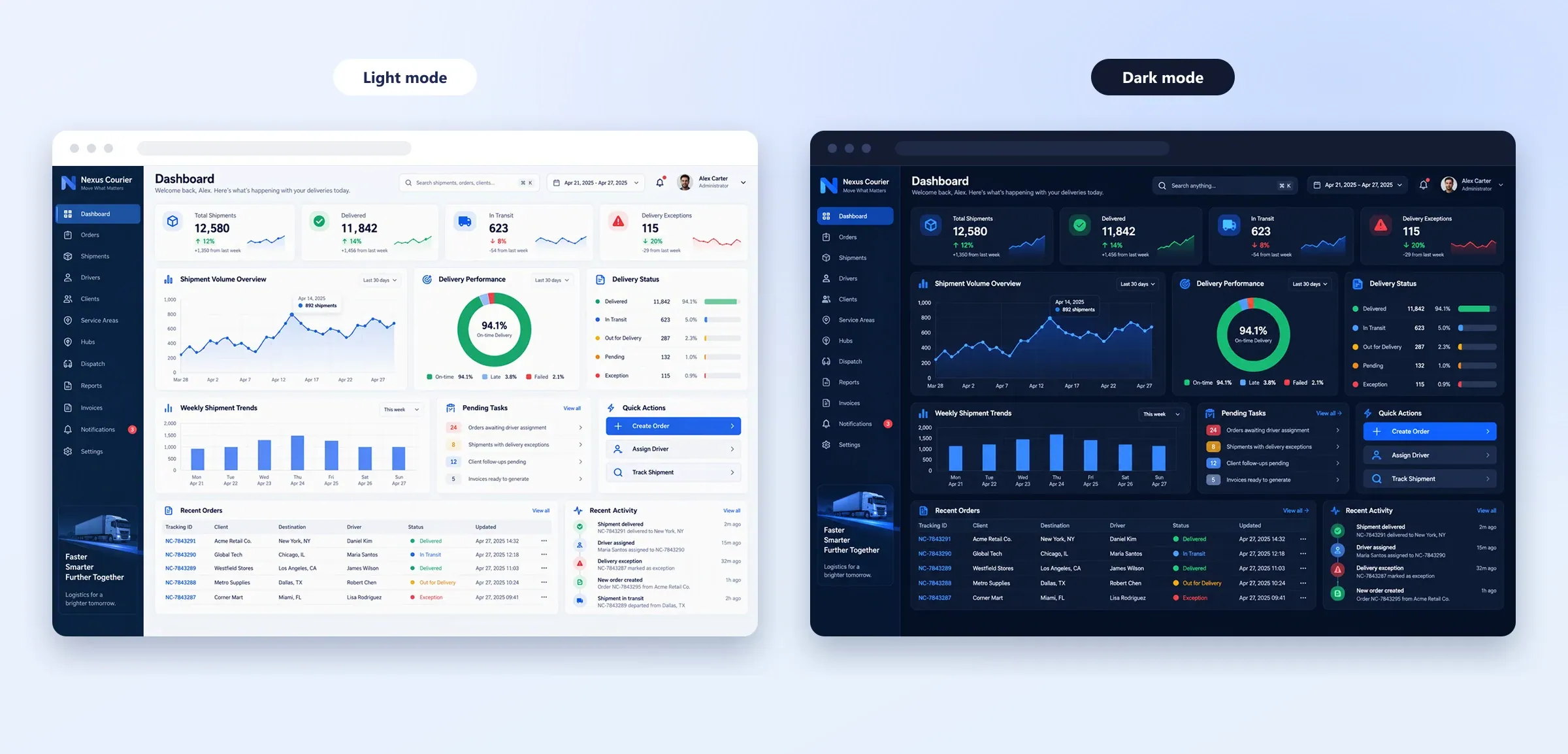
Admin dashboard: full control for the courier operator
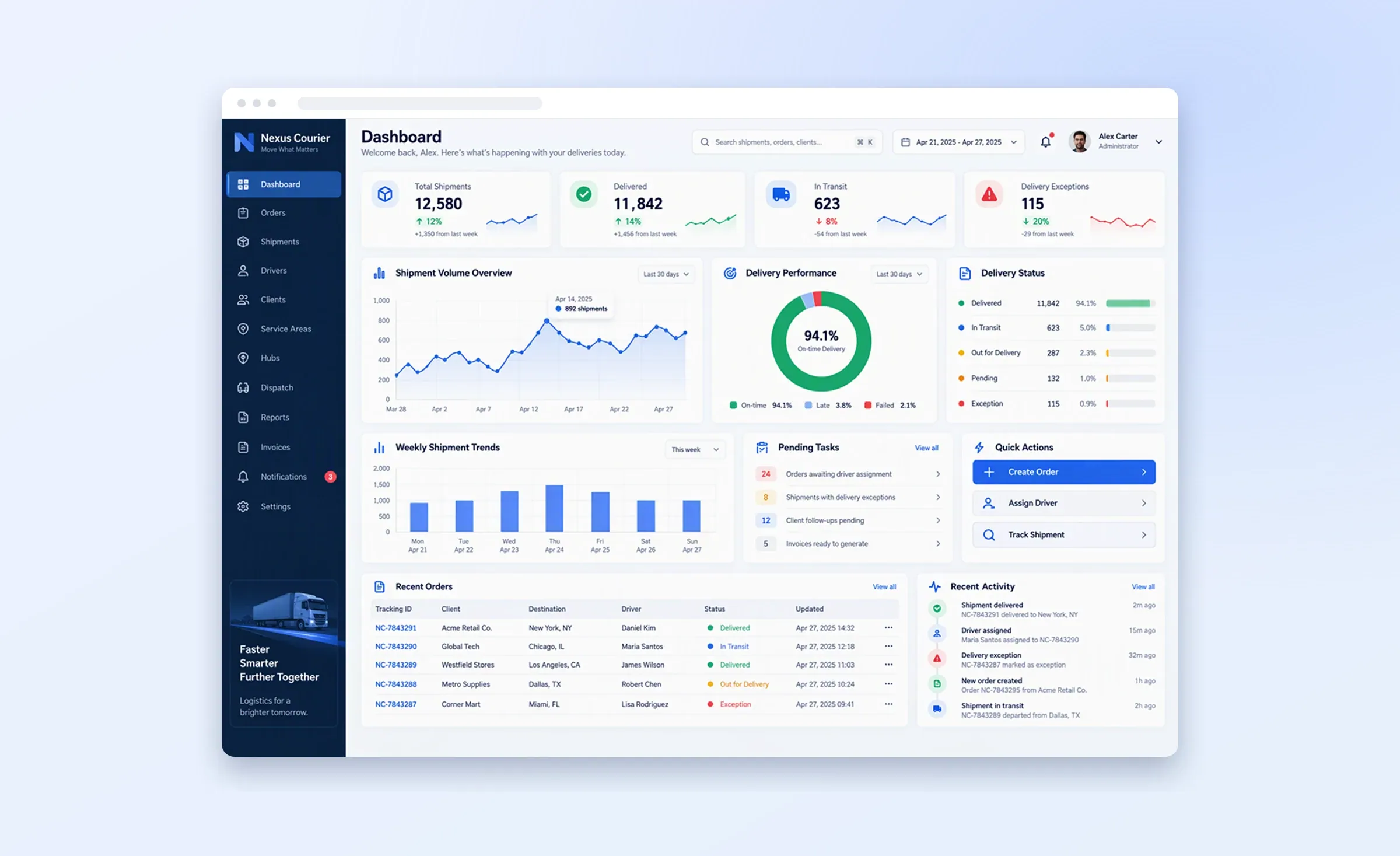
- Operational analytics and performance monitoring
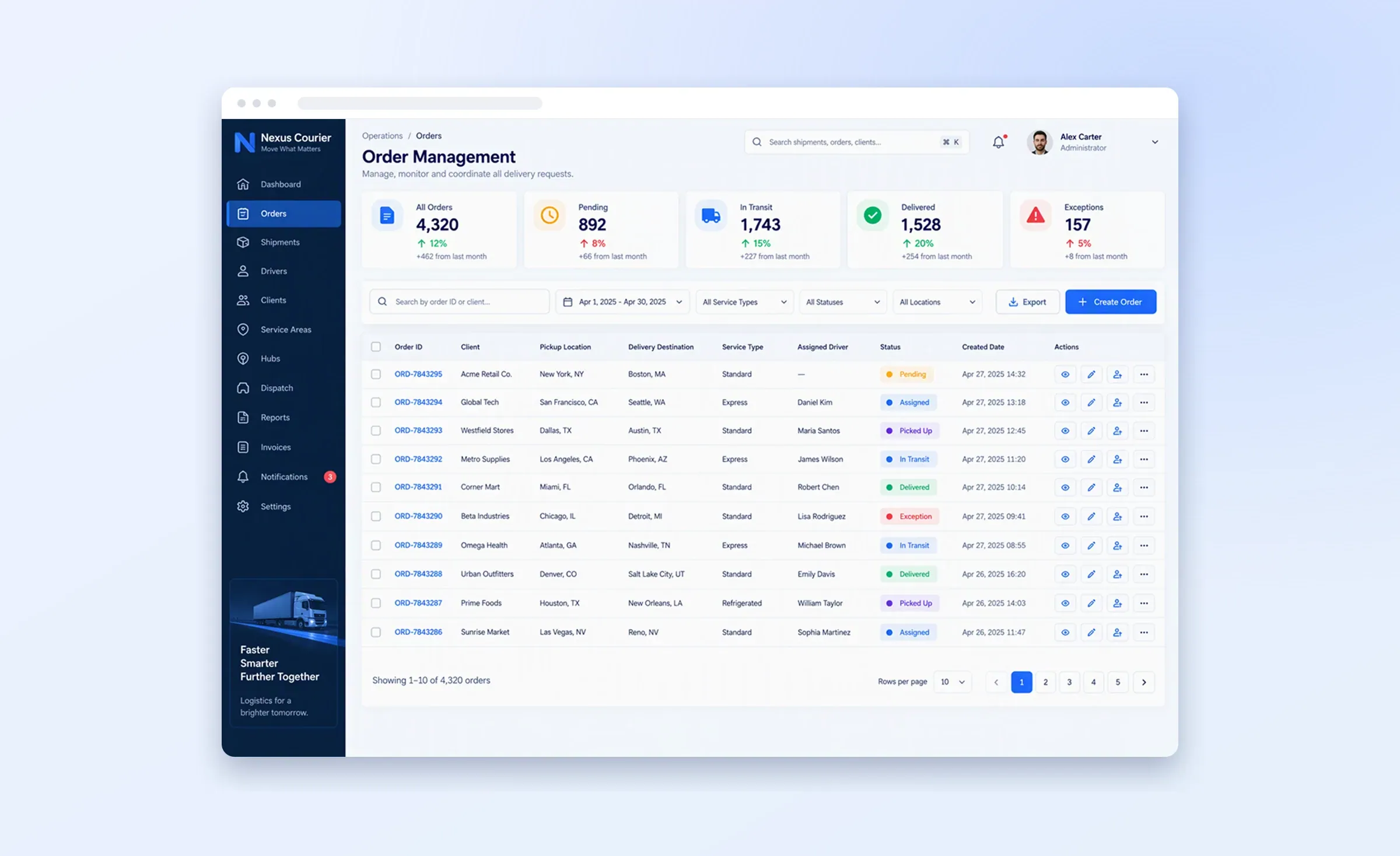
- Order creation, assignment, tracking and management
- Driver onboarding, management and attendance
- Corporate client registration and invitations
- Service areas drawn on interactive maps
- Hub and sorting-bucket management
- Delivery run monitoring and dispatch
- Exception handling and resolution
- Custom roles and permissions
- Invoicing and client billing
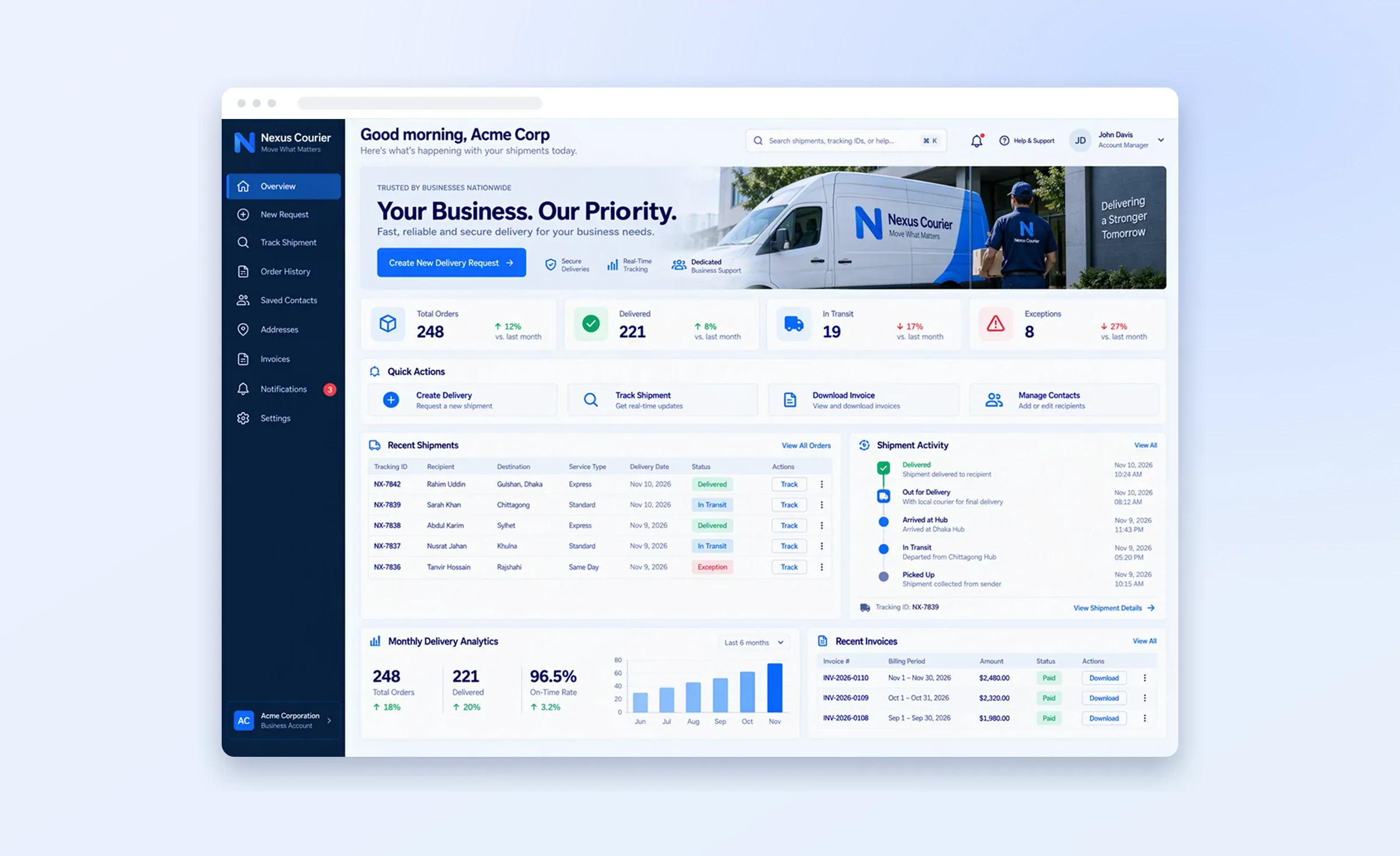
Corporate client dashboard: business customers manage their own deliveries
- Pickup and delivery requests in a few steps
- Route, Rush and Round Trip service options
- Saved contacts and addresses
- Tracking numbers and printable QR shipping labels
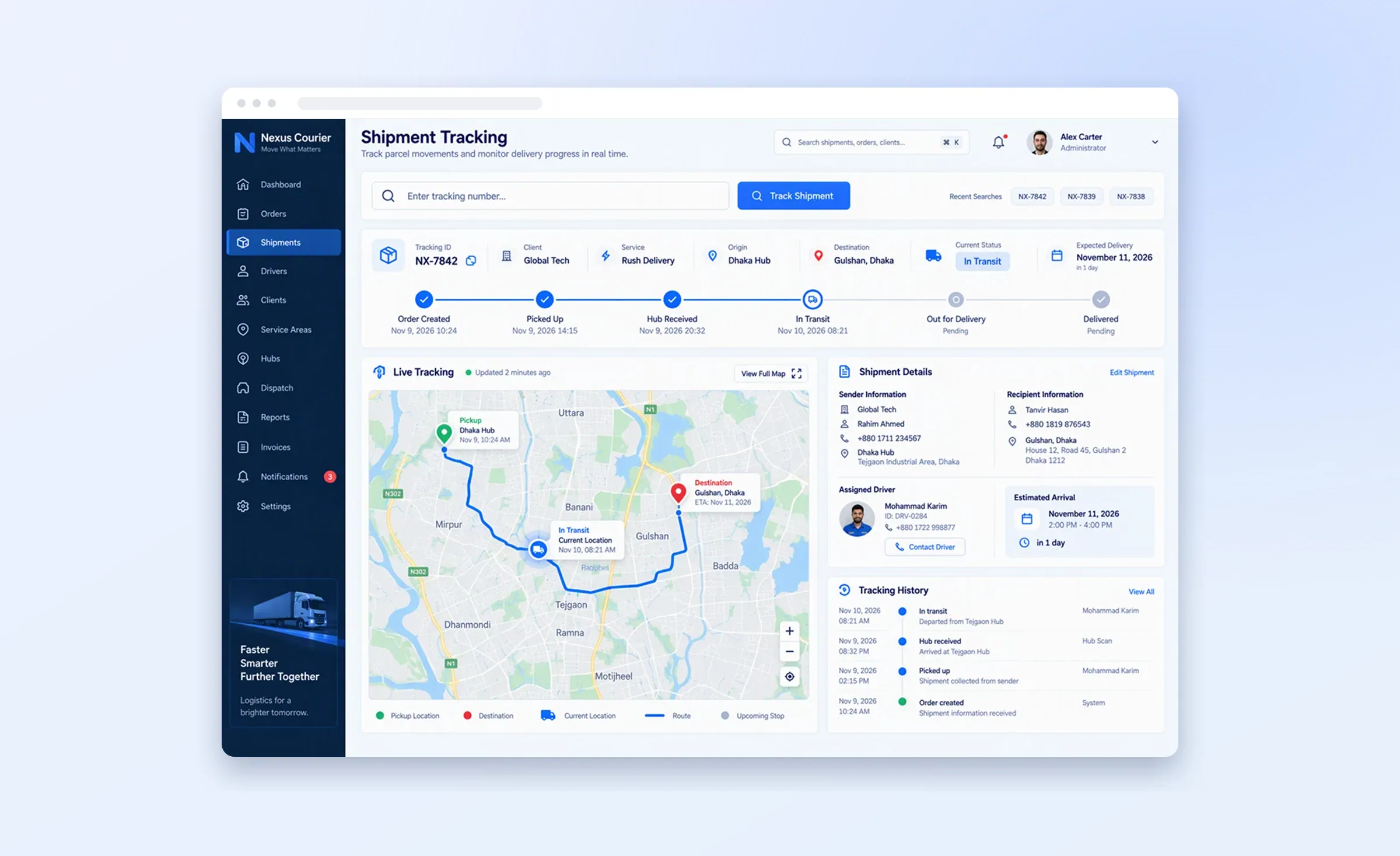
- Live status and tracking timeline
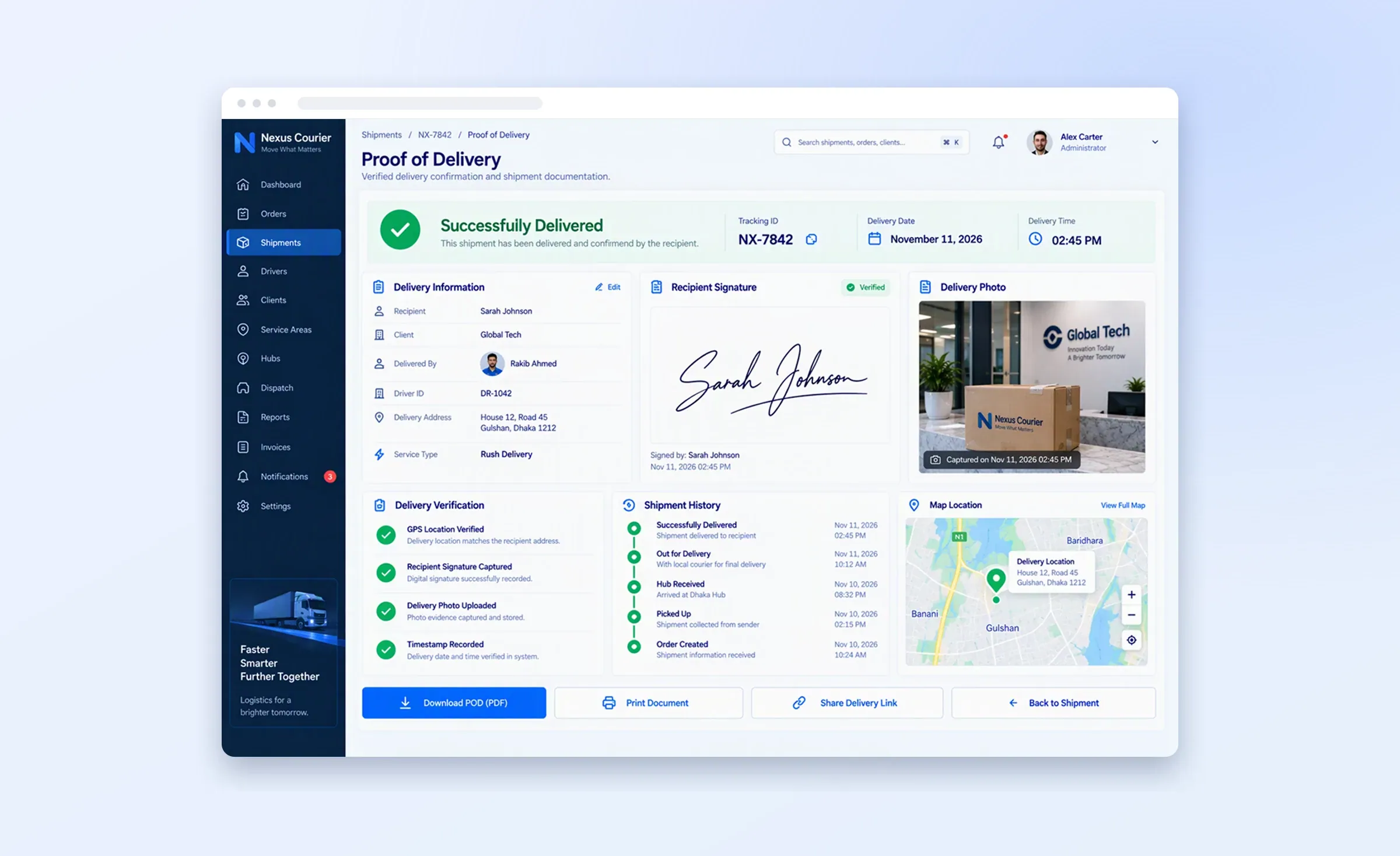
- Proof of delivery with recipient name and signature
- Order history, filters and analytics
- Notification preferences
- Public tracking page, no account needed
Tracking with a chain of custody Every parcel movement is recorded as a scan event: pickup, hub drop and delivery. Each event is timestamped and carries a GPS location, the driver and the parcel. Together they form an unbroken record from first pickup to signed delivery, with exceptions logged and resolved along the way.
Dispatch and hub workflows
- Driver assignment based on workload
- Geographic service areas
- Hub-and-spoke sorting with destination buckets
- Automatic grouping into delivery runs
- Manifest checks when a driver checks out
- Driver-to-driver parcel transfers
- Separate outbound and return flows
Under the hood
The platform behind the dashboards solves several hard problems:
- Multi-tenant: several courier companies share one infrastructure, each with its data isolated.
- Custom permissions: administrators define their own roles and decide who can see and do what.
- Real-time: live updates over WebSockets; notifications and other jobs run in the background.
- Maps and zones: service areas, hub boundaries and address checks rely on geospatial data.
- Scan validation: QR scans and manifest checks stop parcels being handed to the wrong driver.
- Security: JWT sessions with refresh tokens, hashed passwords, optional two-factor login, trusted devices and server-side permission checks.
Platform stack: Next.js · TypeScript · NestJS · Node.js · Socket.IO · PostgreSQL + PostGIS · Redis · Drizzle ORM · BullMQ · Flutter (Android & iOS)
Our part: the Next.js / TypeScript web platform. The backend and driver app were built by the wider team.
What we delivered
- Admin dashboard implementation and refinement
- Corporate client dashboard implementation and refinement
- Order management and tracking interfaces
- Role-specific navigation and screens
- Clear presentation of operational data
- Feature updates as the business requirements evolved
- One consistent experience across admin and client interfaces
The result
Logistics processes that used to be separate now run in one place:
- Courier operations managed centrally
- Clear shipment visibility and traceability
- Accountable, verified handoffs
- Corporate clients who serve themselves
- Structured driver and dispatch workflows
- Coordinated deliveries across service areas
- Consistent records and proof of delivery
“Enterprise software isn't only about features. It means understanding how a business really operates and building systems that make that work clearer, more transparent and ready to scale.” — ZeeTech
More work

Related projects

Calliana —Virtual Receptionist Call Platform
A browser-based call workspace for virtual receptionists: caller ID, client context, scripts, calendars and voicemail in one place.

Supreme Prospects —Athletic Recruitment Platform
A multi-tenant recruitment platform for athletes, parents, scouts, coaches and compliance staff, with recruiting rules built into every message.
Start a project / Project inquiry
Tell us what you’re building.A few useful details are enough.
We use the context to understand the problem before suggesting scope, timeline or the right next step.
Before you send it
Three things make the first conversation useful.
- 01What exists today?A new idea, a current product, or a system that already has users.
- 02What is getting in the way?User problems, technical debt, missing workflows, or delivery bottlenecks.
- 03What should change?The result you want for users, the team, or the business.

Client Stories
VERIFIED CLIENTENDORSEMENTS.
We value each and every client’s feedback which helps us to improve.

“ZeeTech re-architected our entire telematics ingestion pipeline. We went from dropping WebSocket packets during morning dispatch rushes to handling 50,000 live vehicle GPS streams with 18ms latency.”

Marcus Vance
VP of Engineering — FleetPulse Logistics